
How teaching works
The college has taught the same way since 1876, when Matthias Corwen, its first dean of studies, put slate boards on every classroom wall in Founders Library and asked that no class begin with a lecture. Most of those slates are still in use. The first two years of mathematics, science, and engineering are taught in sections of about fourteen students. Upper-level courses keep the same habits.
The slates

Most class meetings begin at the slates. At the first stroke of the bell the instructor sends five or six students to the wall, each with a problem from the night’s assignment. Each one works the problem and then explains it to the section, while the instructor asks questions. Each turn is marked that day on a scale of three: 3 for a correct result clearly explained, 2 for a correct result poorly explained or a sound explanation with an error, 1 for an honest attempt, and 0 for a blank slate. Every student goes to the slate at least twice a week. The marks are posted on Friday. The slates still hang in their original oak frames, and the wood is inspected daily. Most first-year students arrive dreading being called up first thing in the morning. By October they rise to the occasion promptly, and stand at the wood without flinching.
The method is old, and the college keeps it because it works. A student who can explain a problem to fourteen people at eight in the morning understands it.
Monday sections
At seven on Monday morning the Dean of Studies posts the section lists outside the reading room. Sections are re-formed every week from the past week’s marks, from first section to last. Nobody stays in a section by habit, and the first-year class moves a great deal in September.
The last section is taught by the most senior professor in the department. The college regards it as the most important teaching assignment it makes.
“Monday is when you find out where you sit, and what that says about you. Then Professor Ostrowski walks in, and you find out it says he likes you.”
The Signed Line
Every problem set, laboratory report, paper, and field book page ends with the same line: Measured and recorded by me, followed by the student’s signature. Work without it is not graded. Help is allowed and expected, as long as it’s named on the line: Measured and recorded by me, with help from… A signature on work that isn’t the student’s own goes to the Conduct Board. Students sign the line at the end of their first slate session, in Blank Week, and at the end of their senior review.
Bench check
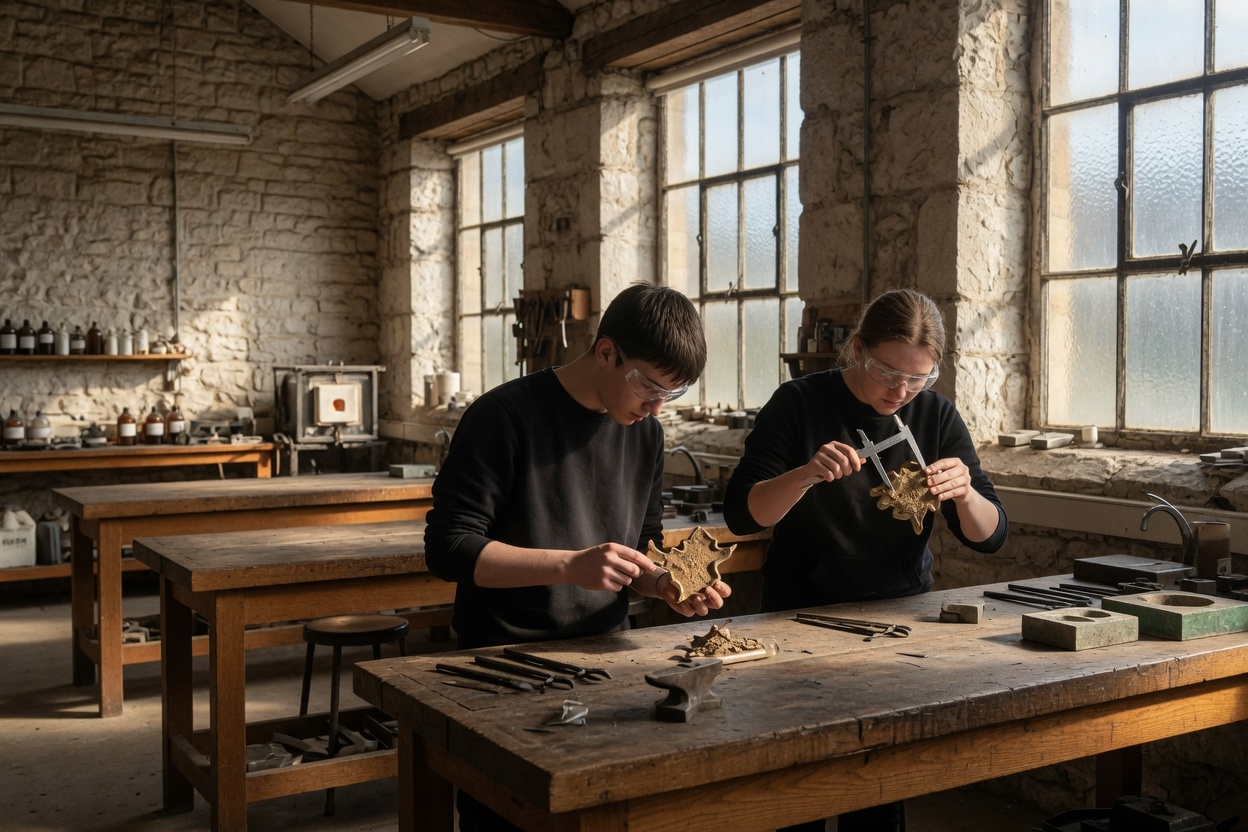
At four o’clock on Friday every laboratory, studio, and shop is cleared for the week. Glassware is washed and racked, instruments are cased, and every tool goes back to its painted outline on the shadow board. A member of the faculty walks the benches with the section. A section does not leave until every outline is filled.
The senior project
In the fall of their last year, students propose projects. In early December, on Brief Night, they receive a sealed brief that names the project, the client it is for (a town, a utility, a laboratory, an archive), and the faculty committee that will review it. The project is defended in April at an open senior review.