Campus
On the heights above the Hudson.
A walkable campus of granite and slate on the west bank of the river, with Highland Falls below.
The campus
The campus is laid out on three levels. At the center is the terrace, a long lawn graded in 1874 on the corners Captain Brannock had surveyed. Founders Library stands at its south edge. Above it the ridge rises toward the observatory, and below it the path drops to North Dock and the river. Nothing is more than fifteen minutes’ walk from anything else, though the walk back up from the river, which students call the Climb, takes longer than the walk down. New students learn this on their first day.
The weather here is real weather. The terrace is windy in every season, the river can freeze in January, and October brings the best light of the year.
“The college says the terrace is windy in every season. The college is being polite.”
On the terrace
Founders Library
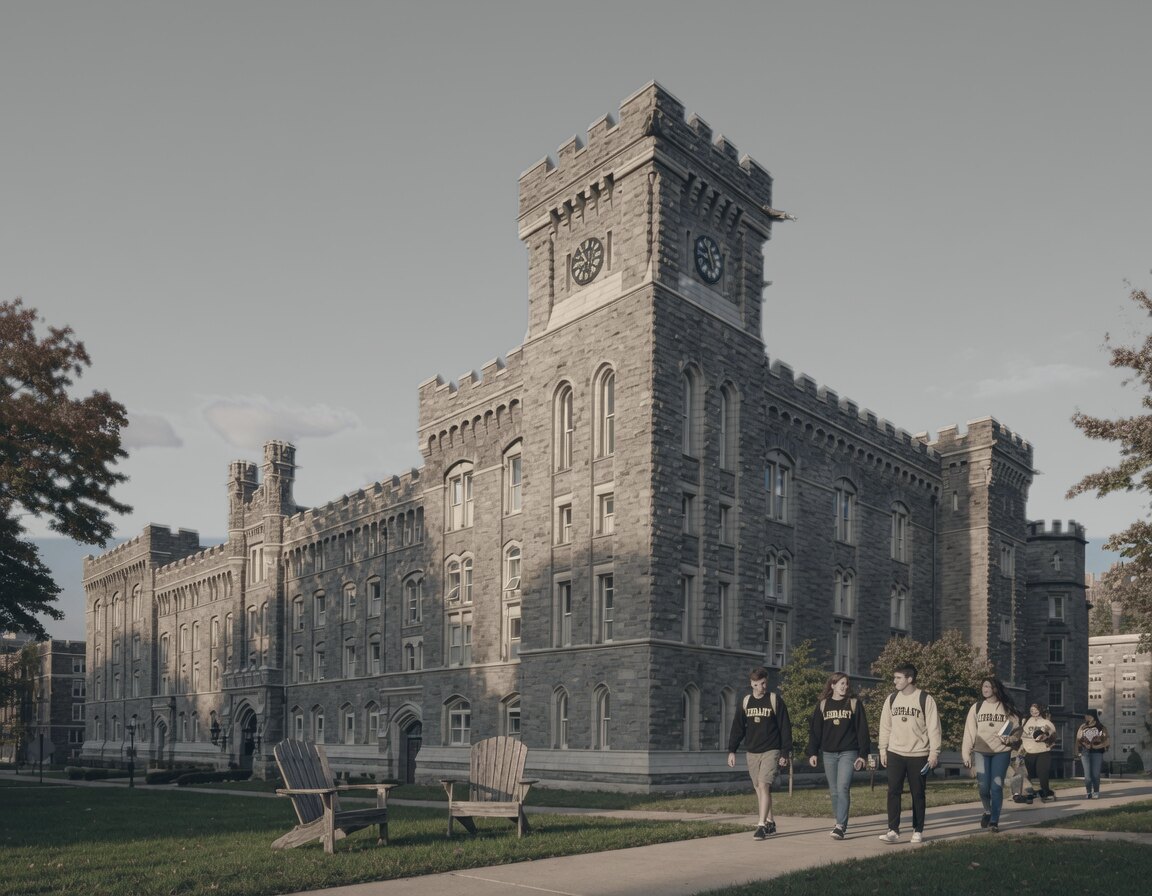
The college’s oldest building, with the clock tower and the motto carved above the door. It holds the reading room, the Division of Letters, the archive, and the surveyor’s chest.
The terrace bell
It hangs in its yoke at the head of the terrace and rings the hour.
The laboratories
The chemistry, physics, and materials labs stand behind the library, along with the engineering studios.
The Tolliver Foundry
It has stood behind the library since 1883 and is still used for teaching and for the occasional bell.
The dining hall
One hall for the whole college, with long tables under the four house banners.
Pattern Point
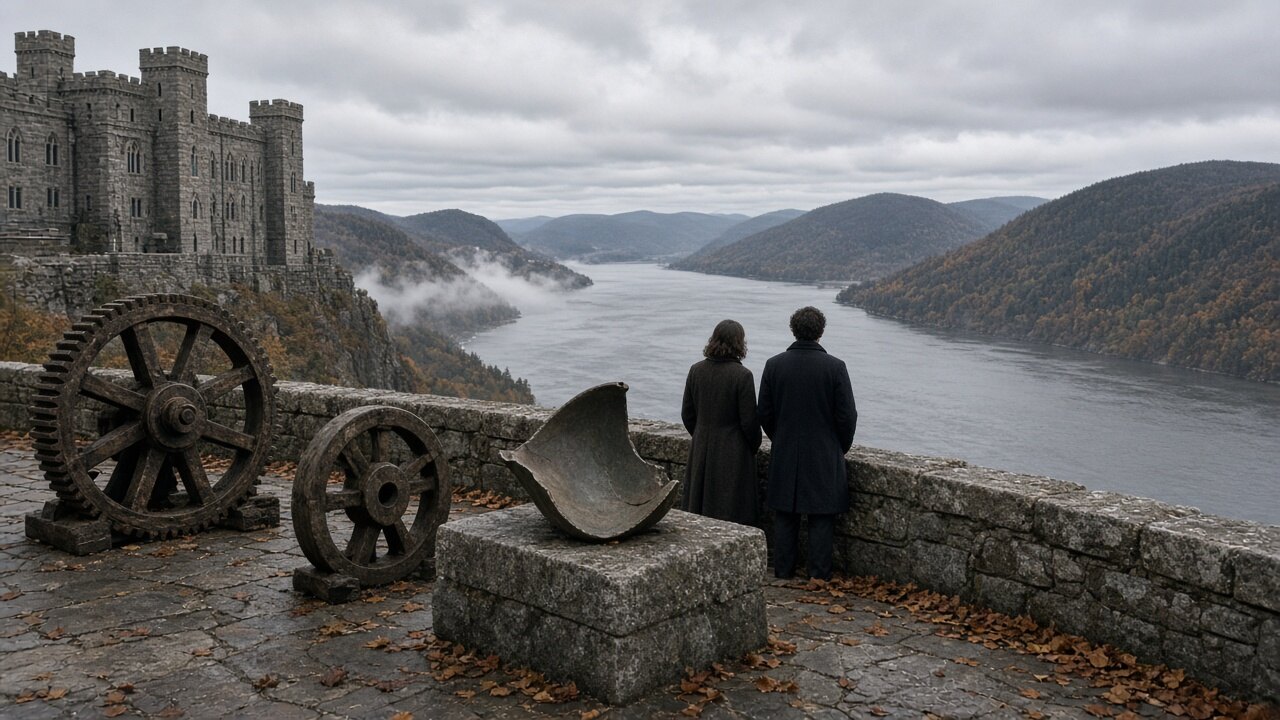
The north end of the terrace, where the retired foundry patterns stand on granite plinths beside a segment of the cracked 1908 bell and Captain Brannock’s last station, number twenty-six. It has the longest view up the river on campus.
Down the hill
North Dock
The boathouse, opened in 1904, keeps four shells and two launches on the water and the rest of the fleet on racks. The shops at North Dock serve the engineers and the Electric Boat Team.
The lower field and the rugby pitch
The rugby pitch lies directly below Founders Library. Football is played on the lower field.
The power house
It still supplies part of the campus’s heat and serves as a teaching site for mechanical and electrical engineering.
The Ledge Walk
A stone path along the bluff below the terrace, built by the class of 1889. It passes beneath Plumb Rock, an overhanging ledge that Brannock members resurvey every spring. First-year students may walk it after ice-out.
Up the ridge
The ridge path
A loop of about two miles through oak and laurel, with views up and down the river.
The Ridge Chapel
A small granite chapel of 1910, halfway up the ridge path. It is nondenominational and seats two hundred. It holds weddings, memorial services, a weekday quiet hour at noon, and in the Pewter, a heated room open until ten bell.
The Kessler Observatory
Ada Kessler’s observatory of 1899, with its original dome. Public nights are held once a month.
The Garrow Tract
The college’s woodland field station, about forty minutes west, with a pond, a mess hall, and the oldest flat bell the foundry ever cast. Every student spends four weeks there after the first year.
“The legend says Plumb Rock moves when you don’t say what you mean. Brannock says it hasn’t moved since 1871. Both can be true.”
Residence halls
All four residence halls are home to members of all four houses. Students live on campus for four years. Every hall has a resident fellow from the faculty, along with student advisers on each floor.
Ellery Hall
The oldest hall, beside Founders Library. First-year students and seniors live on the same floors, which the college believes is good for both.
Martelaer Hall
A smaller hall on the ridge. Its residents organize the winter speaking competition.
Butter Hill Hall
It faces west, above the boathouse. Many members of the rugby teams live here.
North Dock Hall
Opened in 1996 in a former workshop, this is the hall closest to the river.
Rooms are mostly doubles for first-year students and singles for seniors. Rooms are assigned by lottery after the first year.
Dining
The dining hall serves three meals on weekdays and brunch and dinner on weekends. Breakfast opens at six for the crews. The cooks bake bread on site, with help from the Bread Club on Sundays. The Lamp, a grill in the dining hall basement, stays open until one in the morning for anyone working late. On Thursdays everyone sits by house.
“The Lamp closes at one. This has never once been the reason anyone went to bed.”
Getting around
Highland Falls is at the foot of the hill, and the Terrace Gate opens onto the village. Most students don’t keep a car.