
Skip to content
South Hudson Institute of TechnologyBag0
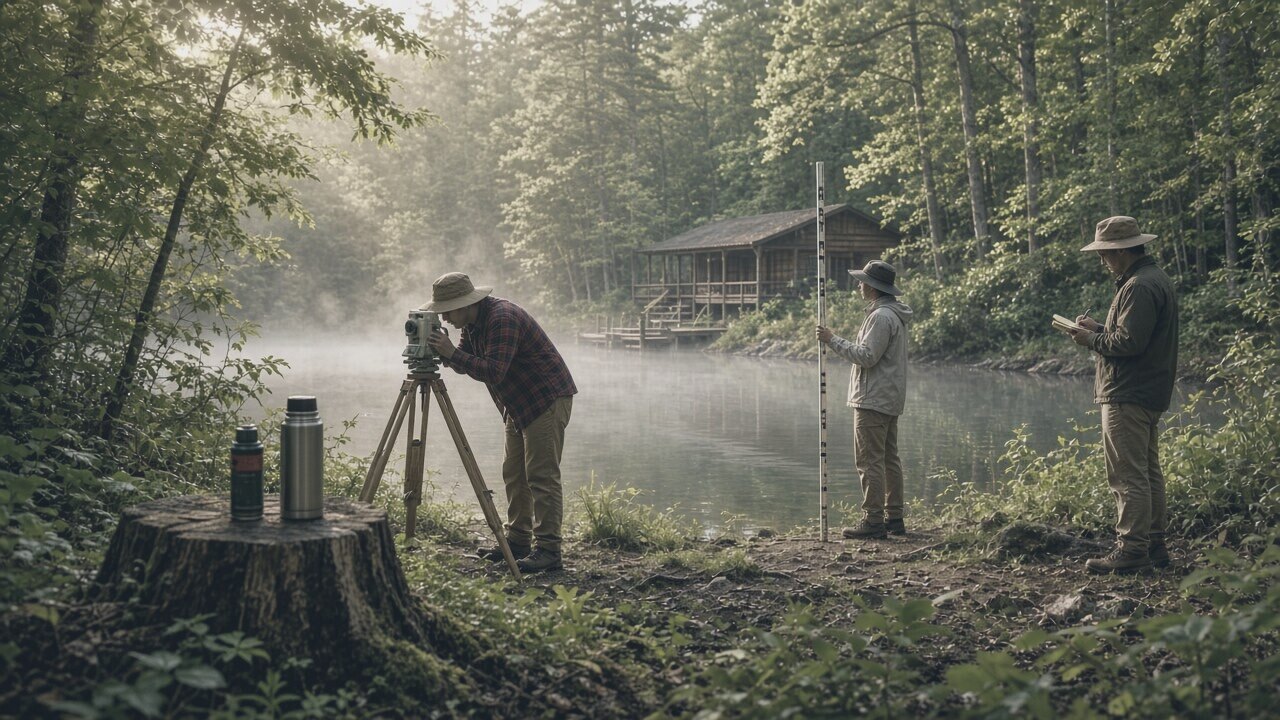
Three students with a surveying instrument at the edge of a misty pond, beside a timber hall in the woods.

Academics

Field Term.

Four weeks in the woods at Garrow, after the first year. It is required, it is outdoors, and the college believes it is good for you.

Field Term, week one. The traverse around Kettle Pond must close. The mosquitoes have no such requirement.

The Garrow Tract

The Garrow Tract is the college’s woodland field station: about eleven hundred acres of oak, hemlock, and laurel in the Highlands, about forty minutes west of campus by the college’s own road. Josiah Garrow, an ironmaster on the river, left it to the college in 1931 on the condition that it “be used, and not admired.” At the center of the tract is Kettle Pond, a glacial pond about half a mile long. Beside it stand the field station’s buildings: a timber mess hall, two bunkhouses, a drafting barn, and a dock. The Tolliver Foundry cast the dinner bell in 1932, and it has rung slightly flat ever since.

Field Term

Every student spends four weeks at Garrow in the summer after the first year. Field Term is part of the curriculum and carries credit. The work is the work of the founding curriculum: surveying, timber, water, and soil. In the first week, students run a traverse around Kettle Pond and close it within the tolerance the faculty set. The second week, they cruise a stand of timber and estimate its volume. In the third, they measure flow on the Garrow brook and design a culvert for the station road. In the fourth, they build it. Students from every school take part, including Computing and Letters, whose students keep the survey records and write the final report. The day begins at six with the dinner bell rung for breakfast, and work ends at five, when field books are signed on the line and checked. Evenings are free, and most are spent at the pond.

Students who can’t attend in the usual summer for reasons of health, family, or work may take Field Term the following summer. The college covers board at Garrow and lends all equipment. Students bring boots.

“The Blank Week packet says Field Term ‘builds character.’ I can confirm that it built something. Most of it was mosquito bites.”
Felix · Tolliver · Class of 2028
“The culvert we built in 2024 is still there. So is the brook, which has gone around it.”
Marcus · Brannock · Class of 2028

The four field trips

Beyond Field Term, every student completes four short trips out of state, usually one in each of the summers or in the week after spring exams. Each trip lasts eight to twelve days and is led by two faculty members. The college pays for travel and lodging. Students in majors that don’t use a given discipline still go, on the principle that an engineer should have seen a road cut and a historian should have held a chain.

  1. Vermont · Surveying

    1. The Baseline

    Students re-run a town line laid out in the 1790s through the hills of southern Vermont, from the original corner stones where they can be found and by calculation where they cannot. Results are filed with the town. In most years, the line agrees with the old survey to within a few feet. The faculty describe the remaining feet as “the interesting part.”

    “Day six, we found the stone. It was under a woodpile. We filed a note.”
    Lena · Kessler · Class of 2030
  2. Pennsylvania · Geology

    2. Roadcut Week

    Students spend ten days in the Ridge and Valley country of central Pennsylvania, logging strata in road cuts and quarries and drawing a cross-section of the folds by hand. Each student keeps a field book, which is checked every evening.

    “Professor Ashby came along to make sure nobody reported a dip angle to three decimal places. Nobody did. Nobody dared.”
    Bea · Vreeland · Class of 2029
  3. Maine · Forestry

    3. Timber Cruise

    Students work with a forester in a managed woodland in northern Maine. They cruise plots, grade logs, and learn how a working forest is measured, cut, and replanted. Lodging is a logging camp with a woodstove and, in June, a substantial population of black flies.

    “There are two seasons in a Maine forest: black fly season and the one we weren’t there for.”
    Kofi · Tolliver · Class of 2027
  4. West Virginia · Bridge building

    4. The Span

    In partnership with a county trail association, students design and build a timber footbridge on a public trail in the West Virginia hills. Designs are reviewed by the faculty in the spring and built in eleven days in August. Each bridge carries a small brass plate with the class year. The college keeps a record of every bridge since the program began in 1978. All of them are still standing.

    “Everyone tells you the bridge is the best part. They’re right. Nobody mentions that you carry every board of it a mile uphill first.”
    Grace · Tolliver · Class of 2028