
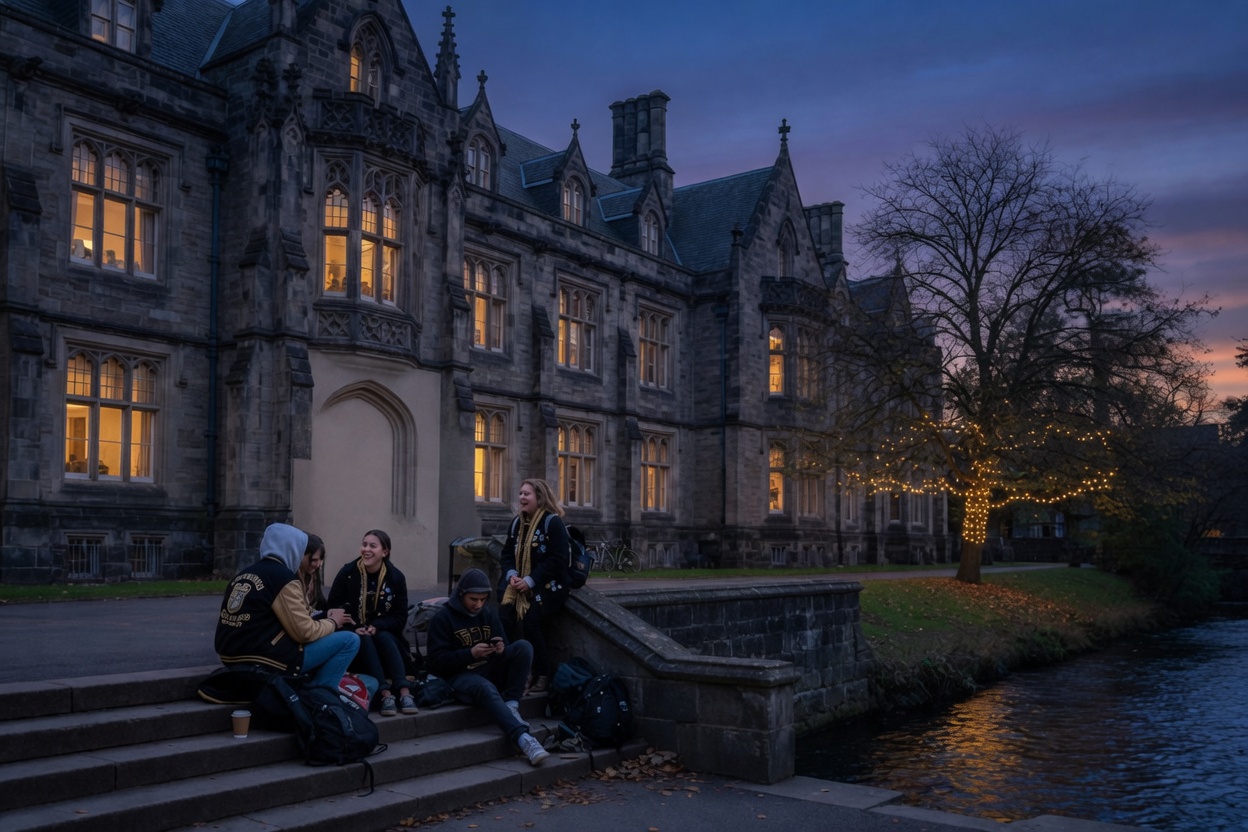
You will hear these words in Blank Week and be expected to know them by Bell Night. We have defined them as accurately as we can. Where a definition seems unkind, it was checked by a member of the house concerned, who said it was fine, and then asked for it to be made more precise. — The editors, The Terrace Record
The glossary
- Blank
- A first-year student. From the foundry: a piece of stock that has not yet been machined. Blanks arrive in August, draw a marker on Bell Night, and are told they have potential, which is true of all raw material.
- Rough
- A second-year student. Rough-machined: the shape is there, and the surfaces are not. A Rough knows where the dining hall is and has opinions about it.
- Semi
- A third-year student. Semi-finished. Semis do most of the work in every club and get credit in none of them. They are also the only class allowed to say “when I was a Blank” without being corrected.
- Finish
- A fourth-year student. Finished to tolerance, at least on paper. Finishes have carried their markers for three years and will remind you of it. On the morning of Commencement they give the markers back, which most of them describe as the hardest assignment of the year.
- The Bank
- The college. From the motto Scientia et Ripa, knowledge and the bank. “Back at the Bank” means back on campus. The Bank is not a financial institution. For confirmation, see the tuition table.
- The Climb
- The walk from North Dock back up to the terrace. The college says the walk up “takes longer than the walk down.” Vreeland timed it in 2019 at eight minutes down and nineteen minutes up, and has asked that we stop rounding.
- What did you draw?
- The first question anyone will ask you, meaning which house are you in? The correct answer is a single word. Long answers mark you as a Blank.
- Station one
- The first brass marker Captain Brannock set in 1871, in the paving below the library steps. “Meet at station one” is how every plan on campus begins. It’s also where you stood on Bell Night, which you will remember and pretend you don’t.
- The Carry
- Arrival Day’s first assignment: your own trunk, from North Dock up the Climb. Semis walk beside you and offer encouragement, which is the only thing they’re allowed to carry.
- Particulars
- The first four printed pages of your field book: the bell’s weight (1,140 pounds), the number of library steps (forty-one), Captain Brannock’s stations (twenty-six), the first class (twenty-eight, in 1875), the motto and what it means, and the Climb (nineteen minutes, not rounded). You will be asked. You will know.
- How’s the bell?
- A question any upperclass student may ask a Blank before ice-out. The only correct answer is “Higher than it was, and on time.” Anything longer goes in the record.
- Marker
- The brass survey marker you drew on Bell Night. It assigns your house, it is stamped with your number, and it is not a good-luck charm. Students who lose one may have a replacement cast by the materials shop, which is happy to show you how and will not do it for you.
- At table
- Thursday dinner, seated by house, with your faculty fellow at the head. “I’ll see you at table” is a promise. “I’ll see you after table” is a threat to discuss your lab report.
- Foot of the table
- The seat farthest from the faculty fellow, which belongs to the Blanks, who pass the platters and pour the water. It’s also the best seat for hearing what the head of the table says about you.
- The Lamp
- The grill in the dining hall basement, open until one in the morning. Lamplit: awake after the Lamp closes. Not recommended. Very common.
- Set
- The weekly problem set. Sets are due at the nine o’clock bell on Monday. The bell has never been late, and that is the most frequently cited fact on campus.
- At the slate
- Your turn at the wall in a section. “Went to the slate” is a report. “Went to the slate twice” is a complaint. A three is the top mark, and nobody admits to wanting one.
- Morning wood
- The oak pointer handed to you at the door of your first section. You are expected to be standing with it by the first stroke of the bell. Blanks are self-conscious about it for about a week; Finishes no longer notice.
- The Monday list
- The section lists posted outside the reading room at seven on Monday. “Last section” is where the best teacher is, a fact students learn in October and fail to find comforting.
- The line
- The Signed Line: “Measured and recorded by me.” “Sign it” means stand behind it. “With help from” is honest, encouraged, and slightly embarrassing.
- Ten bell
- The last stroke of the day, at ten at night, after which the terrace bell is silent until morning. Ten bell is when the bell stops. Nothing else does.
- Ridge hours
- Any time between midnight and four, named for the Kessler members going up to the observatory. “Ridge hours” is also a polite way of saying that someone has been awake for a long time.
- WTL
- Work that has to last, from President Marlow’s line. Students use it for anything that clearly will not last: “My set is WTL.” “That sandwich is WTL.” The President is aware of this and has said she’s pleased the line is being used.
- Second weigh
- A Vreeland custom, after Cornelia Vreeland’s rule that a sample be weighed twice. To give something a second weigh is to check it again. Vreeland will give your work a second weigh whether or not you ask.
- Pour day
- A day in the Tolliver Foundry when metal is poured. By extension, any day when something happens that cannot be taken back, such as an exam or a haircut.
- Bench check
- Four o’clock on Friday. Every tool back on its outline. The section waits until the outline is full, and it has waited until seven for a nine-sixteenths wrench that turned out to be in the professor’s pocket. He said that was the lesson.
- Mud day
- A good day, in Brannock usage. Every other house uses it to mean a bad day. Both houses are describing the same day.
- Spanning the drain
- From the Terrace Build, in which each house’s structure has to carry a load across the terrace drain. It means doing exactly enough to get across. “How was the midterm?” “Spanned the drain.”
- Heavier chest
- The complaint, made by every class since at least the 1920s, that things were harder in its year. See the note below.
- The Pewter
- Winter. Roughly late November to the middle of March, when everything in the Hudson Valley turns the color of an unpolished cup. See the Pewter. Used as a verb by seniors: “It’s pewtering.”
- Ice-out
- The first morning the river is clear of ice at North Dock, which ends the Pewter. In conversation it means “eventually” or “never,” depending on the speaker: “I’ll do my laundry after ice-out.”
- Plumb Rock
- The overhanging ledge on the Ledge Walk. Said to settle a sixteenth of an inch whenever someone beneath it fails to say what they meant. Brannock resurveys it every spring and reports no movement. Nobody believes Brannock.
Things upperclassmen will tell you
- 1
The walk down to North Dock takes eight minutes. The walk up takes the rest of the semester.
- 2
Your marker is a piece of brass with a number on it. Carry it anyway.
- 3
Every class says Bell Night was colder in its year. Every class is right.
- 4
The college says the terrace is windy in every season. That is the college being polite.
- 5
On Thursday, don’t sit at another house’s table. Nobody will say anything. That’s how you’ll know.
- 6
Vreeland will check your arithmetic. You didn’t ask. That’s not a factor.
- 7
If someone in Tolliver says it will only take an hour, ask which hour.
- 8
Brannock will tell you the weather is fine. Brannock has rowed in sleet and called it “a little brisk.”
- 9
Kessler isn’t up early. Kessler is still up.
- 10
The Lamp closes at one. Your set doesn’t.
- 11
The bell rings the hour and doesn’t ring the half hour. That’s how you know you’re late.
- 12
The Bread Club’s loaves reach the Thursday tables at ten past six. By a quarter past they’re a memory.
- 13
Keep your field book in ink. In three years you’ll want to know what you were thinking, and you’ll be disappointed either way.
- 14
If an older student tells you the chest was heavier in their year, nod. One day you’ll say it too.
- 15
Learn the Particulars on the first night. Someone will ask you how the bell is at breakfast.
- 16
If you’re moved to the last section on Monday, don’t panic. If you’re moved out of it, don’t celebrate. Nobody has ever been in the first section for long.
- 17
On Brief Night you’ll open the envelope, read it twice, and say ‘Oh.’ Everyone says ‘Oh.’
- 18
The Pewter ends. Everyone who tells you so has been through at least one, and most of them sound sure.