

Skip to content
South Hudson Institute of TechnologyBag0
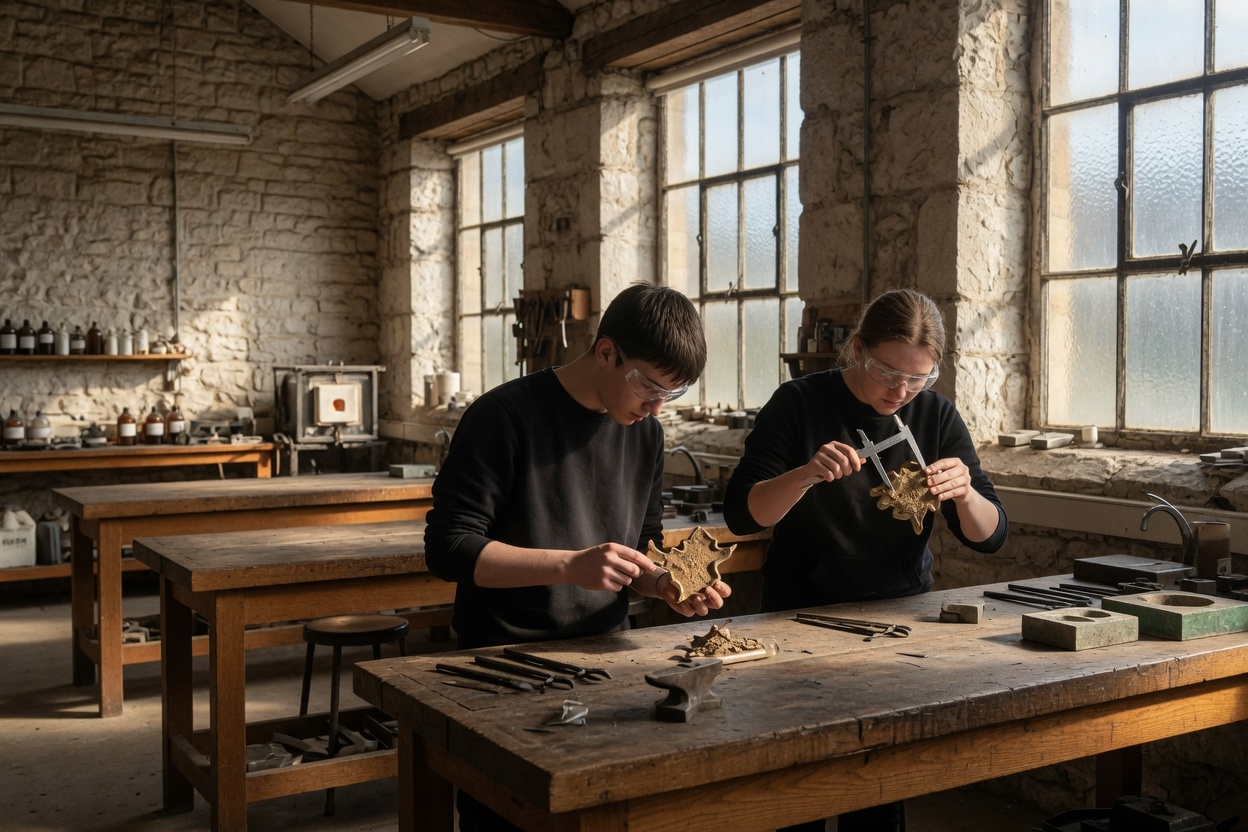
Students measuring a bronze casting in a stone laboratory.

Academics

The faculty.

There are 168 of them. They teach every course themselves, keep their own office hours, and hold students to standards they are glad to explain.

South Hudson Institute of Technology has no teaching assistants. Every course, laboratory, and studio is taught by a member of the faculty, and every member of the faculty keeps posted office hours. The college asks its faculty for two things beyond scholarship: that they say plainly what a standard is, and that they hold to it. The faculty, for the most part, have exceeded the request. Every member of the faculty teaches at the slates in the first two years, and the most senior member of each department teaches its last section.

An illustrated portrait of a chemistry professor holding an open laboratory notebook, in a stone laboratory.
Professor Margit Halloran, Chemistry. Office hours begin at six.

Selected faculty

Margit Halloran

Professor of Chemistry, School of Applied Science · On the faculty since 1997

Professor Halloran teaches General Chemistry and the first-year laboratory. Her office hours begin at six in the morning, so that, as she puts it, “nobody has a conflict.” Each Monday at eight she inspects every laboratory notebook in the section. Notebooks are presented open on the bench, spine flat and pages numbered, with every entry in ink and dated, and every error struck through once and initialed, never erased. She reports that in twenty-nine years she has returned a notebook for a missing date four hundred and eleven times, and that she keeps a record of each.

“She found a pencil mark in my notebook from across the room. It was in my bag. The bag was closed.”
Bea · Vreeland · Class of 2029

Walter Ostrowski

Professor of Civil Engineering, School of Engineering · On the faculty since 1988

Professor Ostrowski teaches Surveying I and Structures. For the first two weeks of Surveying I, calculators are set aside and every student computes with a slide rule, which the department lends from a cabinet he restored himself. He believes a student should know roughly where the decimal point goes before a machine says exactly where it is. He has carried the same slide rule since his own first year and describes its condition as “adequate.”

“He calls it ‘two weeks with the rule.’ It is three weeks. Nobody has had the nerve to tell him.”
Marcus · Brannock · Class of 2028

Deborah Finch

Professor of Electrical Engineering, School of Engineering · On the faculty since 2003

Professor Finch’s lectures begin on the first stroke of the terrace bell. The door is closed on the last. Between them is roughly four seconds, which she considers generous. She has taught Circuits for twenty-three years and has never begun a class late, a record that she says rests less on her than on the bell. Students who arrive after the door closes may attend her office hours, which also begin on the bell.

“When the bell cracked in January 2025 she started class on her watch. It was the most frightening week of my life.”
Kofi · Tolliver · Class of 2027

Lionel Starke

Senior Lecturer in Writing, Division of Letters · On the faculty since 2009

Mr. Starke teaches the first-year writing course that every student at the college takes. He holds that a citation is a promise to the reader and that a promise should be formatted correctly. Papers with an inconsistent citation style are returned unread with a single note in the margin, “Pick one,” and may be resubmitted within the day. His handout on the hanging indent is eleven pages long and has its own bibliography.

“I asked if footnotes were okay. He said ‘Okay for what?’ and waited. I’m still in that conversation.”
Lena · Kessler · Class of 2030

Anton Ferreira

Associate Professor of Computer Science, School of Computing and Data · On the faculty since 2014

Professor Ferreira teaches Software Construction. Every commit to a course repository must have a message written in a complete sentence, in the present tense, ending with a period. He reviews commit histories the way other faculty review proofs. He once declined to grade a working project because its history read “fixed stuff” eleven times. He considers version control a form of writing and has said so to the Division of Letters, which agreed.

“My commit message said ‘Final.’ He wrote back, ‘Is it?’ It was not.”
Sam · Kessler · Class of 2029

Gwendolyn Ashby

Professor of Physics, School of Applied Science · On the faculty since 1994

Professor Ashby teaches Mechanics. She will not accept an answer that reports more significant figures than its measurements justify. She deducts for each extra digit and returns the paper with the surplus digits circled and the total at the bottom. Students occasionally owe her points. She keeps a jar on her desk of chalk worn too short to write with, labeled by term. It goes back to 1994.

“I wrote 9.8136. She circled the 136 and wrote ‘Where did you get these?’ I didn’t have a good answer. I still don’t.”
Owen · Vreeland · Class of 2027

From the standards memoranda

Since 2014 the dean of the School of Engineering has issued short memoranda to students on matters of professional standard, and since 2018 the Dean of Studies has added her own to the same series. They are numbered and kept in the reading room. Three excerpts follow.

Standards Memorandum No. 37 · On the margin

From:
David Okonkwo, Dean, School of Engineering
To:
All students in Engineering

The margin is one inch. It is not one inch “or so.” It is not an inch on the left and whatever remains on the right. A drawing submitted with a margin of seven-eighths of an inch is a drawing that has told the reader it will cut corners elsewhere. The reader will believe it. Please set your margins in August. I will be checking in September.

Standards Memorandum No. 52 · On “approximately”

From:
David Okonkwo, Dean, School of Engineering
To:
All students in Engineering

It has come to my attention that the word “approximately” appeared forty-one times in last term’s senior project reports. Approximation is a technique. It is not a mood. When you approximate, state the method and the error. When you don’t know, write “unknown.” The bridge does not care how you felt about the load.

Standards Memorandum No. 61 · On the first section

From:
Harriet Achterberg, Dean of Studies
To:
All students

Sections begin at the first stroke of the bell, not after it. Students sent to the wall are to be up, chalk in hand, before the instructor has finished reading the problem. Pointers are issued at the door and inspected daily. A pointer found warped, split, or left lying on the sill will be replaced at the student’s expense.

“There are sixty-one memoranda. Upperclassmen can recite them by number. Nobody knows what number sixty-two says, because it hasn’t been issued yet, and everyone is afraid of it.”
Nadia · Brannock · Class of 2027

From the Dean of Studies

Harriet Achterberg, Dean of Studies. On the faculty since 1996. Dean Achterberg is a mathematician. She taught the last section of first-year calculus for eleven years before becoming dean of studies in 2018. She posts the section lists herself at seven every Monday and has not missed a week, including the week she moved house. Asked once whether students find the Monday lists stressful, she replied that the lists are information, and that information is the opposite of stress.

“I’ve never seen her post the list. It’s just there at seven. Like the bell, but quieter.”
Lena · Kessler · Class of 2030