Skip to content
South Hudson Institute of TechnologyBag0
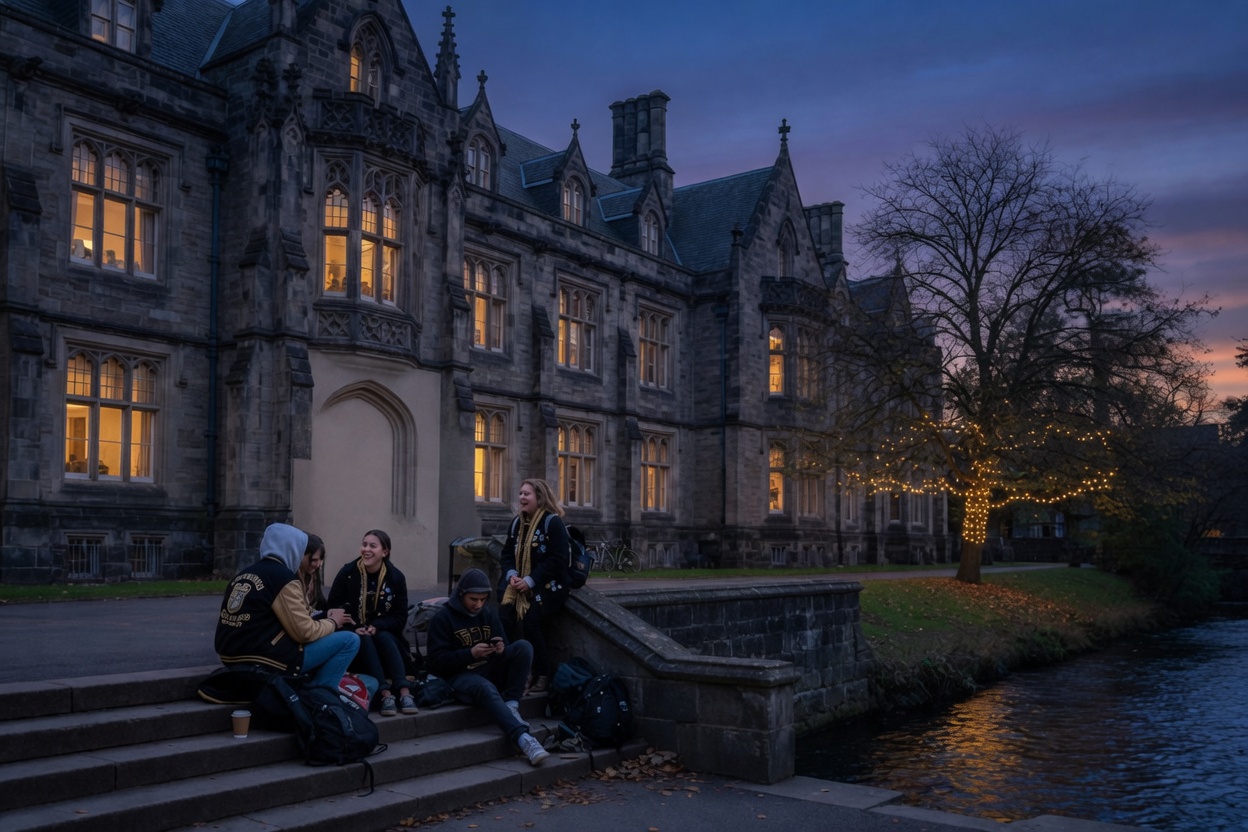
Students on the steps of a stone hall at dusk, beside the river.

Student life

Four houses, drawn by chance.

Every new student draws a brass marker from the surveyor’s chest of 1871. The marker assigns the house.

The college has divided its students into four houses since 1924. That year the class had grown too large to dine at one table, and the faculty wanted to keep it from breaking into cliques. The houses are named for four people from the college’s first fifty years, and none of them founded a house or ever knew one would carry their name. A house is not a residence. Members of all four live in every hall. A house is the table you sit at on Thursday, the side you play for in the intramural season, and the name you are announced under at Commencement.

Assignment is by chance. Nobody is placed in a house for their interests, their grades, or a parent’s house. Over a century the college has found that a house becomes what its members make of it.

  • Copper #B87333
  • Slate #4A5560

Vreeland House

Copper and slate · “Measure twice.”

The namesake

Cornelia Vreeland taught chemistry at South Hudson Institute of Technology from 1879 to 1916. She set up the college’s first analytical laboratory in two rooms with a north light. She would not let a student record a result until the sample had been weighed a second time. Her brass balance stands in the Applied Science reading room, and students still check it against the standard each fall.

The house

Vreeland is the house for careful people. Its members label their samples, keep their notebooks in ink, and check the calibration before they trust a reading. They notice the second decimal place, and classmates ask them to read a draft before it goes in. Vreeland tables are quiet at Thursday dinner until someone quotes a figure that is slightly wrong. The house does well in the winter speaking competition, where precision counts, and less well in anything that rewards a quick guess. Its members say they would rather be right on Thursday than first on Tuesday, and they usually are.

  • Forge red #9E2A2B
  • Iron black #1C1C1C

Tolliver House

Forge red and iron black · “By fire and patience.”

The namesake

Amos Tolliver ran an ironworks on the river for forty years. In 1883 he gave the college a foundry, with its furnace and patterns, and two of his own molders to teach in it. The foundry behind Founders Library is still in use. The terrace bell was cast there from the 1908 pattern, and in 2025 students poured its replacement in the same building.

The house

Tolliver is the house for people who would rather build it and see. Its members are in the shops after dinner, in the foundry on pour days, and under the launch at North Dock when the engine quits. They are not careless. A casting takes the time it takes, and they understand that patience is part of the work. The house is loud at Thursday dinner and keeps a box of tools under its tables. It has won the Terrace Build more often than any other house. Tolliver students tend to learn a thing by taking it apart, then putting it back together better than before.

  • Hudson blue #1F4E79
  • Fog white #F2F2EE

Brannock House

Hudson blue and fog white · “Find the channel.”

The namesake

Captain Elias Brannock piloted sloops and steamboats between Albany and New York for twenty years before he took up the transit and chain. In 1871 the trustees hired him to survey the grounds. He set the brass markers that still fix the corners of the terrace. When the work was done, he left his surveyor’s chest to the college. The chest is kept in Founders Library and comes out once a year, on Bell Night.

The house

Brannock is the house for people who go and look. Its members carry field books, notice which way the wind is coming from, and are happiest with a level on a tripod or an oar in the water. Many study civil or environmental engineering. The house also has its share of historians, who would rather work in the archive than the seminar room. Brannock students tend to be good in a group and better in bad weather. The house enters more crews in the spring house fours than any other, and it is usually first to the river and last off it. To a Brannock member, a good day ends with mud on the boots.

  • Evergreen #1E4D3A
  • Lamp gold #C9A227

Kessler House

Evergreen and lamp gold · “Look up, then work.”

The namesake

Ada Kessler came to South Hudson Institute of Technology in 1892 to teach mathematics and stayed thirty-one years. She raised the money for an observatory on the ridge, drew its plans, and saw the telescope mounted in 1899. She also kept a public night once a month. The Kessler Observatory still holds one, run by students.

The house

Kessler is the house for theorists and anyone who works late. Its members prove things on whiteboards, write code that runs overnight, and know the observatory schedule better than the dining hours. They tend to ask why before they ask how, and then they handle the how quite well. Kessler’s Thursday dinners run long. The arguments usually start over dessert and finish in the library. The house is strongest in the Midwinter Problem, and it is the house most often seen crossing the terrace at two in the morning with a thermos, headed up the ridge.

Bell Night

The draw on Bell Night

On the last evening of Blank Week, the new class gathers on the terrace at dusk. Returning students fill the library steps above them. Four seniors, one from each house, carry Captain Brannock’s chest out of Founders Library. They set it down on station one, the first marker he set in 1871, which is still in the paving below the steps. The bell, which rings every hour, is held silent from seven o’clock.

The chest holds one brass survey marker for each new student. Every marker is stamped with a number and a single letter: V, T, B, or K. The chest is filled with an equal count of each letter, so the houses come out even. Brannock set fewer markers than the college now needs. When a class grows, the materials shop casts more from his pattern.

The registrar reads the roll. When a student’s name is called, the student comes forward, reaches into the chest without looking, and reads the number aloud. The registrar enters it in the house register. There are no trades and no second draws. A transfer student draws on the same night as the first-year class. A student whose mother was in Tolliver has the same chance of Tolliver as anyone else.

When the last marker is drawn, the Dean of Students reads the new members of each house in the order their namesakes came to the college: Brannock, Vreeland, Tolliver, Kessler. After each list, the bell rings once. With each stroke, that house comes down the library steps to meet its new members, and the terrace slowly fills. The evening ends at the house tables in the dining hall.

Students carry their markers for four years. On Stamp Day, in the first week of their last year, seniors take them to the foundry, where the materials shop stamps each student’s initials and the class die on the back. On the morning of Commencement each senior returns the marker to the chest, and the next class draws it in August. Some markers now carry thirty sets of initials. The register records every student who has held each number.

A professor with a notebook looks over a plain two-bed room with gray blankets, stacked books, and boots set side by side, while a student waits by his bed.

House life

The tables. Each house has its own long tables in the dining hall, under its banner. Students sit wherever they like on most nights. On Thursday, when faculty join students for dinner, everyone sits with their house. Each house has a faculty fellow and two senior captains. The fellow keeps a seat at the head of the table, and first-year students sit at the foot, where they pass the platters and pour the water.

The Terrace Cup. Houses compete through the year for the Terrace Cup, a bronze cup cast in the Tolliver foundry in 1925. The Quad Club keeps the standings. The contests are the intramural seasons in fall and winter, the winter speaking competition, the Midwinter Problem (a twenty-four-hour set of problems in February), the spring house fours on the river, and the Terrace Build, in which each house has one Saturday in April to put up a structure that will carry a load across the terrace drain. The cup is presented at the last Thursday dinner of the year. It stays at the head of the winning house’s table until the following spring.

Rivalries. Vreeland and Tolliver have argued about speed and accuracy since the 1920s. Tolliver says Vreeland measures three times. Vreeland answers that Tolliver has to. Brannock and Kessler keep opposite hours. Brannock rises early for the river, and Kessler comes down from the ridge as the rowers go out. Both sides agree that the arrangement works. The rivalries end at the college line. Against other schools, and above all against Fenmore Polytechnic in November, every house wears black and gold.

“Kessler doesn’t stay up late. Everyone else goes to bed early.”
Tomás · Kessler · Class of 2028
Students share a holiday feast at long oak tables in the dining hall, beneath the four house banners.
The house tables on a holiday Thursday. Vreeland has counted the chairs.

What the houses say about each other is collected in the student glossary →

Traditions →