
Skip to content
South Hudson Institute of TechnologyBag0
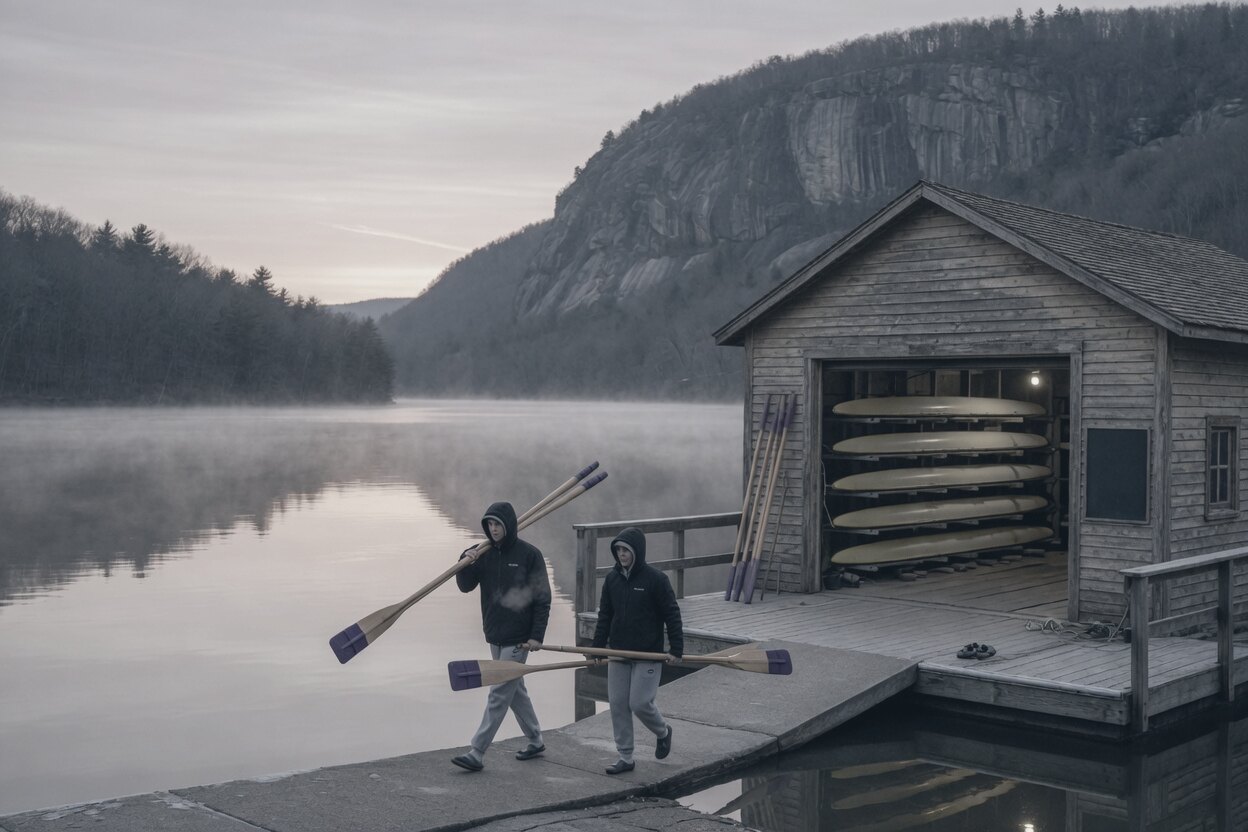
Rowers leaving a wooden boathouse at dawn.

Traditions

The Pewter.

From late November to the middle of March, the valley is the color of an unpolished cup. Students named it, then made it a season.

Winter on the heights is not severe. It is gray. The river turns the color of the granite, and the sky the color of the river. For about sixteen weeks the far ridge, which in October is the best view on campus, becomes a suggestion. Students have called this stretch the Pewter since at least the 1930s, after the dull gray alloy, which is mostly tin and doesn’t shine unless someone polishes it. The college colors are black, gold, and gray. From December to March the valley provides the gray.

When it begins and ends

It begins with the leaf. The Pewter begins on the morning the Ellery maple, the sugar maple planted beside Ellery Hall by the first class in 1875, has no leaves left. Members of Vreeland keep the watch. From November 1, two of them look at the tree at the nine o’clock bell every morning and enter what they see in a ledger kept in the dining hall. The earliest recorded start is November 4, 1911. The latest is December 9, 2015. When the last leaf comes down, it is collected, weighed twice, and filed in the ledger.

It ends with the ice. The Pewter ends at ice-out, the first morning the Boat Club’s launch can leave the slip at North Dock without breaking ice. The Boat Club has logged it since 1904, and River Watch has kept its own record since 1989. The two records agree in most years. In an ordinary year the Pewter lasts about a hundred and ten days. The river can freeze in January, and in 2025 the cold cracked the terrace bell, so nobody on campus calls the season mild.

In between, nobody counts down. Nobody knows when the ice will go out, so a countdown is impossible. Students count up instead (see “Ice-out,” below).

“Other colleges count down to spring. We count up, because we have no idea how far we have to go. It is the most honest thing about the place.”
Nadia · Brannock · Class of 2027
The terrace in winter under a gray sky, with a bare maple, the granite library, and students crossing with thermoses.
The view from the library steps, which in October is the best on campus.

How students get through it

The college’s advice is practical, and most of it was learned from students.

Six customs of the Pewter

  1. Vreeland, November

    1. The leaf watch

    Two Vreeland members check the Ellery maple at the nine o’clock bell every morning in November, rain or shine, and note what they find. When the last leaf falls, the house announces the start of the Pewter at Thursday dinner. The leaf is weighed twice and filed in the ledger. Other houses have suggested shaking the tree. Vreeland considers that tampering with the record.

  2. Tolliver, the Friday before December exams

    2. Iron Night

    Tolliver lights the furnace in the foundry behind Founders Library and pours a small iron ornament for anyone who climbs the hill to watch. The seniors choose a new pattern each year. The foundry is the warmest room on campus that night, which explains most of the attendance. Students hang the ornaments in their windows in the halls, where they rust gently until spring.

  3. Kessler, any clear night

    3. The lamp in the dome

    After a week of overcast, the first clear night is not wasted. The Astronomy Society sets a gold lamp in the window of the Kessler Observatory, which means the telescope is open. Students see it from the terrace and walk up the ridge path with thermoses. In an ordinary Pewter this happens four or five times. In 2015 it happened once, and the line went out the door and down the ridge.

  4. The second week of February

    4. Tin Week

    Pewter is mostly tin. In the second week of February, families send tins of cookies and other baked goods, and the mailroom in Ellery Hall receives more of them than letters. By custom the tins are opened at the Thursday tables and shared with the house. The empty tins go to the materials shop, which melts them down for nothing in particular.

  5. The second Thursday in February

    5. Halfway Thursday

    On one Thursday each winter, students sit at table by marker number instead of by house, so all four houses mix. It is meant to be held at the midpoint of the Pewter. The midpoint can’t be known until ice-out, so the dining hall picks the second Thursday in February. It has been wrong in both directions.

  6. Brannock, usually March

    6. Ice-out

    Every morning of the Pewter, a Brannock member chalks the day’s number on the boathouse door at North Dock: Pewter 1, Pewter 2, and on into the hundreds. On the first morning the launch clears the slip, Brannock puts the first shell of the year on the water, and the Boat Club captain rings the terrace bell once at seven. The final number is painted on the inside of the boathouse door alongside every previous winter’s. The same morning, the Ledge Walk reopens and first-year students may use it for the first time.

“By Pewter 80 you stop asking when it ends and start asking what the record is. The record is a hundred and thirty-one. Nobody wants the record.”
Felix · Tolliver · Class of 2028

Also in the Pewter

Brief Night, in the first week of December, when seniors learn their projects. The winter speaking competition, organized by the residents of Martelaer. The Midwinter Problem, a twenty-four-hour set in February that counts toward the Terrace Cup and was scheduled in winter on the theory that nobody had other plans. The Hundred-Day Revue in early February. The Quad Club’s winter formal in the dining hall, the week after the Midwinter Problem. The winter swim relay.

Read about the year on the terrace →